



Kling 4.0 is already publicly available on Kling's official website. Its API opens for first-wave integrations at 11:00 p.m. Beijing time on October 21, 2026 (11:00 a.m. EDT in New York on October 21). Enkio will begin deploying Kling 4.0 API support on October 22 Beijing time as part of that first wave. Here is a music video sample, generated by Kling 4.0 for your reference:
Introduction to Kling 4.0: What's New
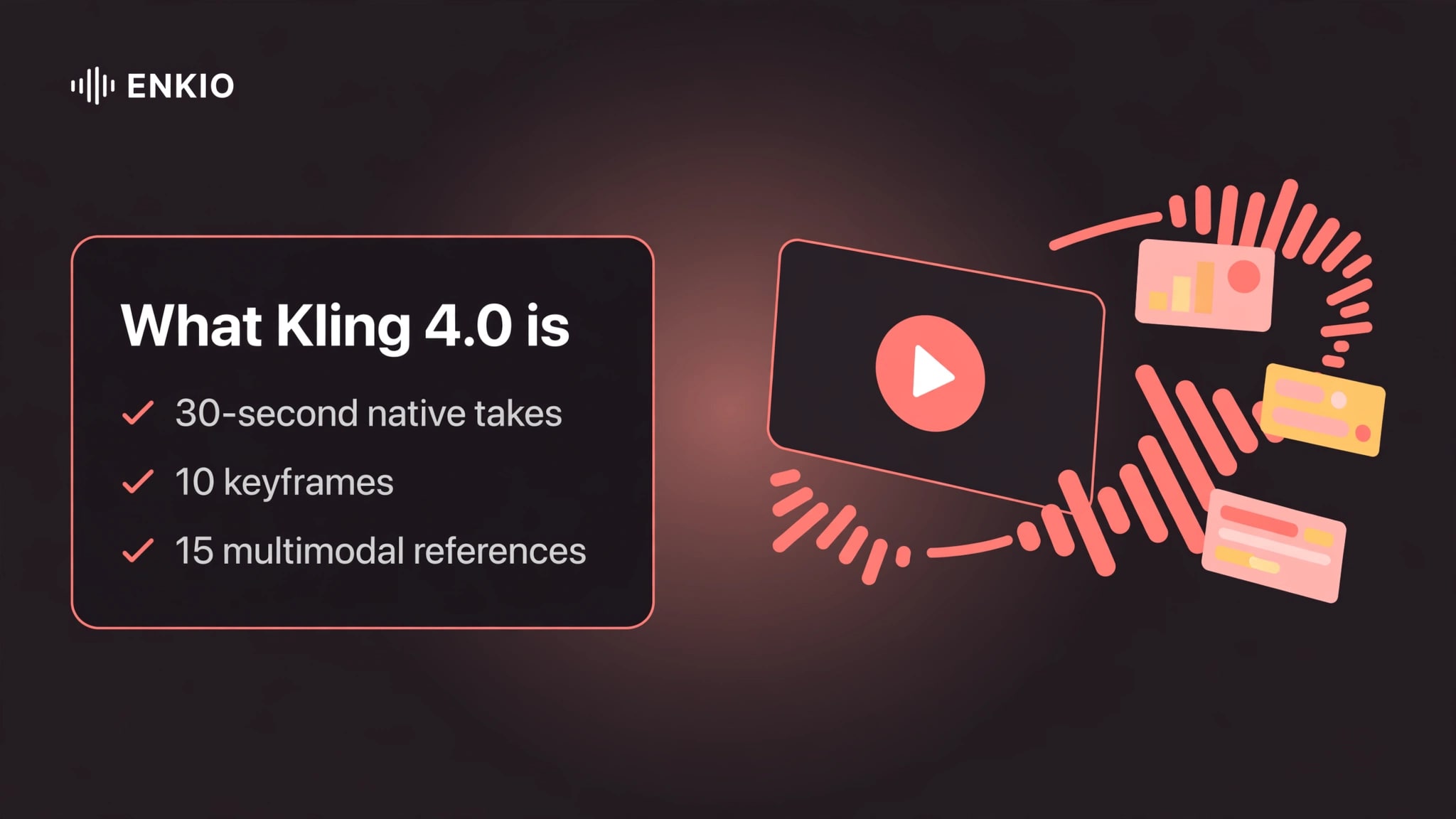
Kling AI announced Kling 4.0 on September 28, 2026, and the model is now publicly usable on Kling's official website. The API rollout is separate: first-wave integration access begins at 11:00 p.m. Beijing time on October 21, 2026 (11:00 a.m. EDT in New York). The announced capability set reads like a wishlist drawn up by music video directors:
- Native 30s Generation (native 30-second generation per clip)
- Multiple Keyframes (up to 10 per generation) for shot control
- Omni Reference (up to 15 multimodal references combining images, video, voice timbre, and subjects)
- Dynamic Motions (stable motion in high-intensity scenes)
- Sound Effects with high-quality stereo audio
- More accurate Lip Sync across Multiple Languages, Accents, and Dialects
- Enhanced Video Editing and Video Extension — all at up to 4K/1080p Resolution with 10-bit HDR output.
The launch brief positions Kling 4.0 as a new-generation native multimodal model for more stable complex motion, stronger all-purpose reference consistency, and more coherent, precisely controllable storytelling — a shift from generating isolated clips toward creating controllable finished videos. Its music-focused optimizations cover AI music videos, lyric visualizations, virtual-idol clips, artist visual assets, karaoke and music-social content, stylized creative shorts, and multiple visual styles built around the same track, with an emphasis on audiovisual synchronization, stylistic range, and emotional expression.
For context, the current generation of models behind most AI video tools tops out at much shorter native clips, which is why AI music videos today are often assembled from many small fragments. A 30-second native take changes the unit of production from the fragment to the scene.
What this means for music videos
Full songs get real narrative arcs. A three-minute track no longer has to be a montage of disconnected six-second shots. With Native 30s Generation and Video Extension, one continuous take can carry a full verse — the walk through the city, the performance building to the chorus — and Video Extension extends the story instead of restarting it.
Dance and performance stop smearing. High-motion scenes — choreography, running, crowd movement — are where current models visibly struggle, a challenge we have documented before in our Revid AI Music Video Generator Review. Kling 4.0's announced Dynamic Motions — stable movement in high-intensity scenes — target the footage music videos are made of.
Characters stay themselves. Omni Reference (up to 15 multimodal references) means the artist's face, outfit, and style can be anchored across every scene of a video. For artists building a visual identity across releases, consistency is the difference between a collection of clips and a recognizable world.
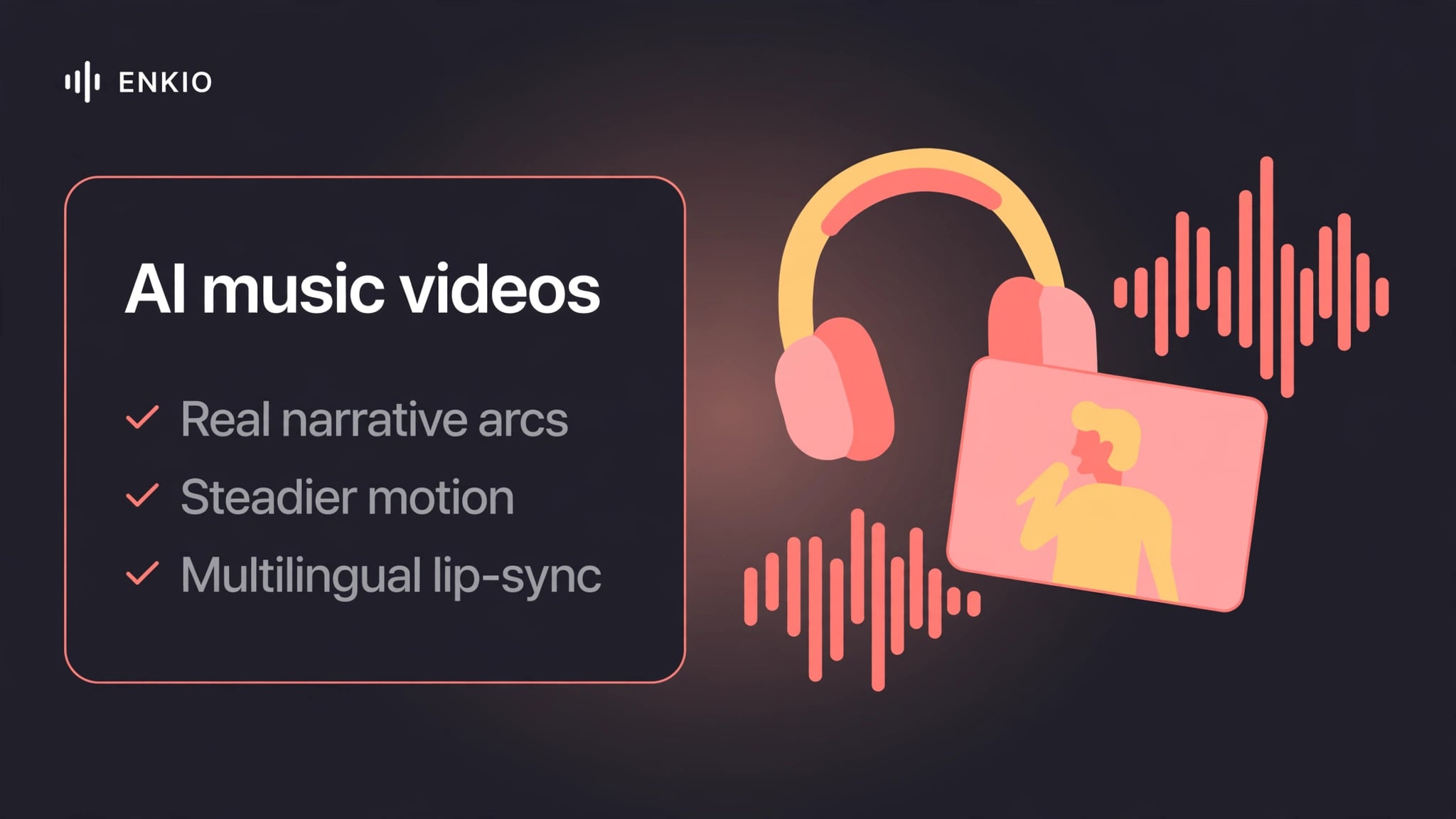
Global releases get believable lip-sync. Lip Sync across Multiple Languages, Accents, and Dialects means a Spanish version, a Korean version, and an English version of the same video can each look like they were actually performed — not dubbed. Combined with two-channel stereo Sound Effects, dialogue and performance scenes arrive closer to finished.
These are the capabilities the pipeline is being prepared to absorb. Enkio begins deploying the API integration on October 22 Beijing time as part of the first wave; as deployment progresses, the AI Music Video Generator will route eligible generations through the new capabilities automatically.
How it works: nothing for you to configure
We don't ask you to pick a generation model, and that is deliberate. The workflow stays exactly as it is today:
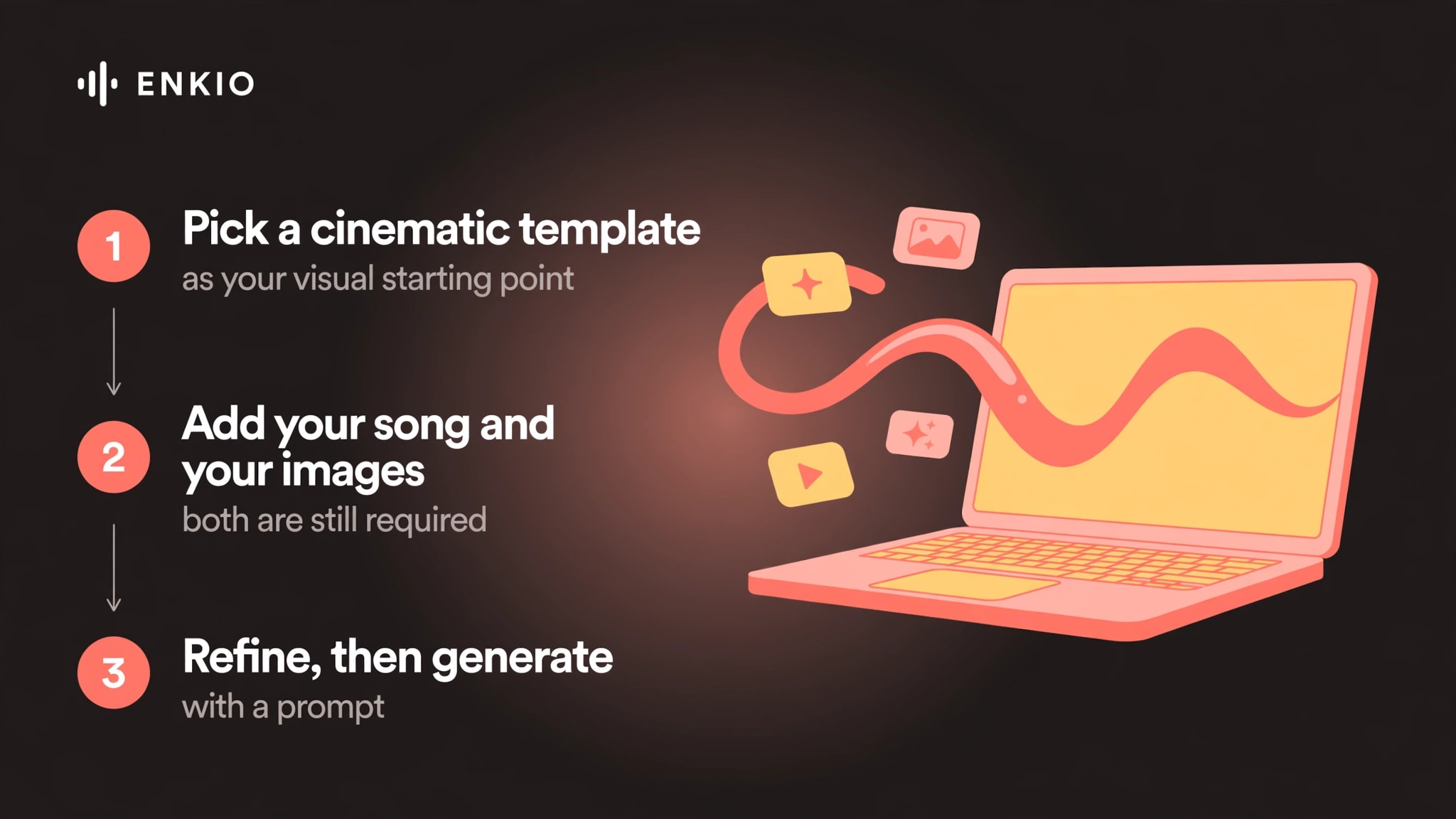
1. Pick a cinematic template as your visual starting point.
2. Add your song and your images — both are still required.
3. Optionally refine with a prompt, then generate.
Our Enkio Review walks through the full workflow step by step. Behind that simple flow, our backend selects the generation stack for each render. As Enkio's Kling 4.0 API deployment begins on October 22 Beijing time, the new capabilities join that stack automatically — no model picker to learn, no settings to toggle, no "upgrade" button. Your existing templates, Solo MV Mode, Two-Person MV Mode, and Ultra Mode MV workflows keep working; the footage they produce gets the benefit of the new generation capabilities. If you also need the track itself, our AI Music Generator covers the music half of the project.
Here is a MV generated by Kling 4.0 below. You can input your personal photos, and then a MV will be output soon, focusing you as the main character:
This is the practical advantage of a managed pipeline over a model picker: you get the improvement without the homework. If you have ever compared model version numbers before rendering a video, you know what we are saving you from.
Real limitations of Kling 4.0
Kling 4.0 is already publicly usable on Kling's official website, but website availability and API integration are separate. The API opens for first-wave integrations at 11:00 p.m. Beijing time on October 21, 2026 (11:00 a.m. EDT in New York), and Enkio begins deploying support on October 22 Beijing time. Anything in this article describing Kling 4.0 capabilities describes the announced capabilities; availability inside Enkio's pipeline follows that deployment.
Output specs improve with the models, not before them. Music videos here currently render at 720p and 1080p. Higher resolutions and longer native takes arrive as the new generation capabilities roll out; treat 4K and 30-second workflows as planned capacity for now.
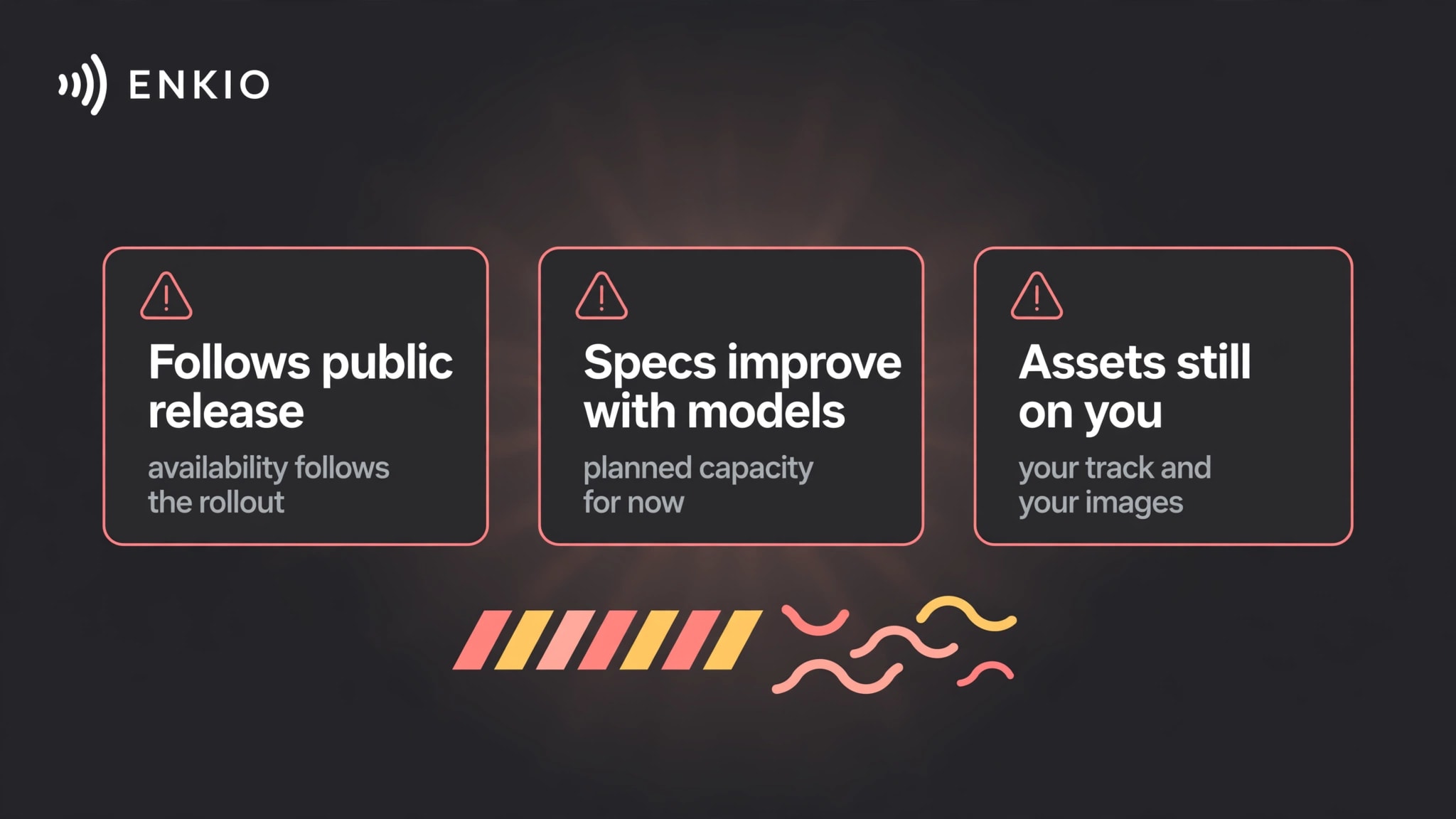
Music and image assets are still on you. The generation model handles motion, performance, and visuals — it does not write your song or supply your artist photos. Every MV still needs your track and your images, and the quality of what you put in remains the ceiling of what comes out.
Check your plan before planning big. Generation features and export quality vary depending on your plan, so confirm what your tier includes before starting a major project. Current plans and pricing are on Enkio's pricing page — as always, confirm the details there rather than assuming from an announcement.
Frequently asked questions
When will Kling 4.0 support arrive?
Kling 4.0 is already publicly available on Kling's official website. Its API opens for first-wave integrations at 11:00 p.m. Beijing time on October 21, 2026 (11:00 a.m. EDT in New York), and Enkio begins deploying support on October 22 Beijing time. There is nothing to sign up for and no beta list — the capabilities arrive in the normal generation flow as deployment progresses.
Will I need to select Kling 4.0 as a model?
No. The app selects the generation model automatically. You will never see a model picker, and you will not need to change any setting to benefit from the new capabilities.
Will my existing templates and projects still work?
Yes. Templates, Solo MV Mode, Two-Person MV Mode, and Ultra Mode MV are workflow layers above the generation model. They keep working exactly as today; only the rendered footage benefits from the upgraded capabilities.
Does this change what I need to provide for a music video?
No. You still provide the song and the images, with an optional prompt. Kling 4.0 changes how well the video is generated, not what goes into it. If you are starting from scratch on the music itself, our Best AI Music Generators roundup covers the track-creation side.
Will Kling 4.0 generations cost more credits?
That has not been announced. Credit costs in the app depend on the generation settings you choose, and the app shows the cost before you render. Current plan details are on the pricing page.
Conclusion
Kling 4.0's announced capabilities — Native 30s Generation, Dynamic Motions, Omni Reference-based consistency, Lip Sync across Multiple Languages, Accents, and Dialects — map almost one-to-one onto what AI music videos need most. Our job is to make that upgrade invisible: the same three-step workflow, the same templates, better footage.
If you are planning a release around these capabilities, the useful preparation is the same as always: get your track mixed, gather strong artist images, and pick your template. Enkio begins deploying Kling 4.0 API support on October 22 Beijing time as part of the first wave and will handle the rollout inside the pipeline.
Plan your next music video.
Generation features and export quality vary depending on your plan — compare current plans before you start a project.